
Court Records After a Jail Arrest in Orange County
Court records after a jail arrest in Orange County are not created by the jail roster alone. The Orange County Jail roster is an Orange County Sheriff's Office custody tool. It can show a Sheriff's Office Number, arrest date, offense ID number, book memo, court abbreviation, warrant number, bond amount, fine amount, and bond number. That is useful for identifying the arrest event, but it is not the final court docket.
After a person is booked, the Orange County District and County Attorney may accept, reject, amend, reduce, enhance, or refile charges. Krispen Walker Winfree is identified by the county as the elected District and County Attorney, and the office represents the State of Texas in Orange County criminal cases except some minor matters filed in municipal or justice courts. For current custody information, use jail inmate records. For booking-photo questions, use the separate mugshot and records-request route.
Jail Charges Are Not Always Court Charges
The roster charge is often the first public clue, not the finished prosecution record. Orange County's inspected inmate detail showed a charge table with offense description, warrant number, fine amount, court, bond amount, bond number, and offense memo. Those fields help identify the case path, but a prosecutor can later change the charge language, add a count, dismiss a count, or file a different charging instrument.
This difference matters when a person searches court records after an arrest and sees a mismatch. The jail may still show the book memo from intake, while a clerk's system may show a formal misdemeanor information, felony indictment, lower-court complaint, or no filed case yet. A very new arrest may also appear in custody before it appears in a court index.
| Record Type | Primary Source | What It Can Show |
|---|---|---|
| Booking or jail record | Orange County Sheriff's Office | Custody status, arrest date, book memo, offense ID, bond, warrant, and jail identifiers. |
| Court record | County, district, municipal, or justice court clerk | Filed charge, case number, hearings, orders, dispositions, and certified copies. |
| Prosecutor record | Orange County District and County Attorney | Charging decisions, amendments, dismissals, victim services, and prosecution activity. |
How to Find Orange County Court Records After an Arrest
Start with the jail roster only long enough to collect identifiers. The official roster link from the Sheriff's Corrections Information page opens a public Orange County table, and the detail page can provide the court code and warrant or bond references needed for the next step. Court records after an arrest should then be checked through the correct clerk or court channel.
- Open the Orange County Jail roster and search by name, Sheriff's Office Number, arrest date, or offense information.
- Use View Details to capture the full name, birth date, arrest date, offense ID number, book memo, court code, warrant number, bond amount, and bond number.
- Match the court code to the likely court path. JP and municipal abbreviations usually point to lower-court matters; county and district abbreviations point to misdemeanor or felony routing.
- Use the Orange County County Clerk, District Clerk, issuing municipal or justice court, or Re:SearchTX if that case type and court are available there.
- Ask the clerk for certified copies, older files, or records not visible online.
The County Clerk Online Records Search page is an official county source, but the inspected instructions describe official public records and imaged books rather than a dedicated jail-charge docket. The page warns that some links can be blocked by firewall or network settings, that online search is intended for a computer instead of a phone or tablet, and that some browsers may need Adobe Acrobat to view images. District-court questions should route to the District Clerk page. Statewide electronic access may be available through Re:SearchTX, subject to participating-court coverage and account terms.
The county's online records instructions are useful because they warn users about desktop access, browser limits, and image viewing before a search begins.
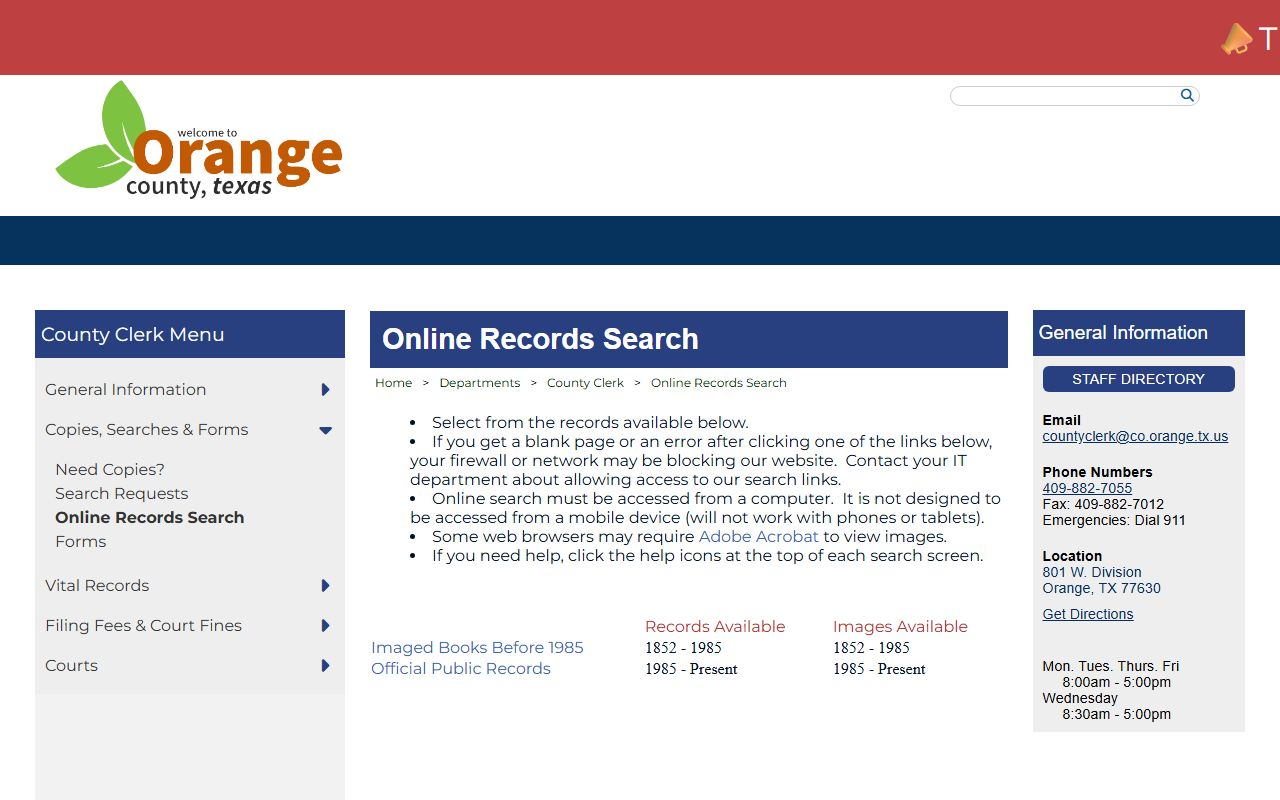
Those access notes help explain why a court-record search after an Orange County arrest may require a clerk contact or Re:SearchTX check instead of a phone-only search.
Charging Documents After an Orange County Arrest
The court file usually turns on the charging document. A complaint is a sworn allegation that can begin many criminal processes. An information is a prosecutor-filed charging instrument used for many misdemeanors. An indictment is a grand-jury charging instrument used for many felonies. The jail roster can point toward the alleged offense, but the filed charging document is what the court uses to track the formal accusation.
| Document | Typical Role | Where to Look |
|---|---|---|
| Complaint | Starts or supports a criminal allegation, often before or with lower-court proceedings. | Issuing court, clerk, or law-enforcement records channel. |
| Information | Prosecutor-filed charge for many misdemeanor cases. | County court or County Clerk pathway, depending on the case. |
| Indictment | Grand-jury charge for many felony cases. | District court and District Clerk pathway. |
If a charge has not yet been filed, the clerk may have no matching case even when the person is still in custody. Check again after prosecutor review, or call the relevant clerk with the exact identifying details from the roster.
Charge Status in Court Records After Arrest
Charge status is the part of court records after arrest that most often changes. An arrest entry can remain easy to find while the case itself moves from pending to amended, reduced, dismissed, or disposed. In Orange County, the District and County Attorney handles felony and most county criminal prosecutions, while municipal or JP matters may stay in lower-court channels.
| Status | What It Means |
|---|---|
| Pending | The charge or case is unresolved. Future hearings, plea activity, or prosecutor action may still occur. |
| Amended or reduced | The prosecutor or court changed the charge, count, level, or wording from an earlier version. |
| Dismissed | The charge ended without a conviction on that count. Other counts may still remain. |
| Convicted or adjudicated | The case reached a guilty finding, plea, or other final adjudication reflected in the court record. |
Bond, Fines, and Holds After Arrest
Texas bail is governed by Code of Criminal Procedure Chapter 17, and Orange County roster detail shows bond information at the charge level. The inspected sample included a court code, a bond amount, and a bond number. The public detail did not show bond type or payment instructions, so a person should verify the practical release path with the sheriff or the correct court before traveling.
| Term | How It Works |
|---|---|
| Cash bond | Money is paid directly under court or jail rules, subject to the case outcome and applicable costs. |
| Surety bond | A licensed bail bond company posts a bond where allowed. The court and jail still control conditions. |
| PR bond | Personal recognizance release depends on a written promise to appear and comply with conditions. |
| No-bond or hold | A charge, warrant, parole or probation issue, detainer, immigration hold, or magistrate decision may prevent release by payment alone. |
Fine amount is not the same thing as bond amount. Orange County warrant rows can show both bond and fine columns, especially for lower-court or fine-only matters. A bond may allow release while a case continues. A fine can reflect money owed or assessed by the issuing court.
Warrant Channels That Can Lead to Arrest Records
Orange County publishes an official County Warrants page that links to an All Active Warrants portal. The inspected portal displayed a Search by Name function and public rows with name, birth date, age, court, warrant number, warrant date, alleged offense, bond amount, and fine amount. Visible court examples included municipal, JP, county, and district-style abbreviations.
The county warrant page directs people with warrant information to call the Orange County Sheriff's Office at (409) 883-2612. That phone channel is important because internet listings can lag court action. For lower-court warrants, the issuing municipal or justice court may be the place to confirm payment plans, recalls, clearance, or appearance requirements. For warrant records not shown online, use the sheriff's written records-request process under the Texas Public Information Act.
Charges vs. Convictions in Court Records
An arrest or filed charge is not a conviction. The roster and early court record describe an accusation and custody event. A conviction requires a guilty plea, verdict, or other final adjudication. Treating a charge as a conviction can create a serious error, especially when charges are later dismissed, reduced, or never filed in the form suggested by the booking memo.
| Charge | Conviction | |
|---|---|---|
| Stage | Accusation after arrest or prosecutor filing. | Final adjudication through plea, verdict, or qualifying court outcome. |
| Proof | Based on probable cause or charging decision. | Based on proof beyond a reasonable doubt or a knowing plea. |
| Record risk | Can be changed, dismissed, or superseded. | Can affect sentencing, supervision, rights, and later record searches. |
Sealed vs. Expunged Court and Arrest Records
Texas Code of Criminal Procedure Chapter 55A governs expunction of qualifying arrest and criminal records. Expunction is not the same as a casual online removal request. It is court-based relief for eligible outcomes, such as certain dismissals, acquittals, or other qualifying circumstances. If an expunction is granted, agencies may have duties to remove or return records according to the order.
| Sealed or Nondisclosed | Expunged | |
|---|---|---|
| Public view | Restricted from ordinary public access where the order applies. | Treated under the expunction order as erased or removed from covered public records. |
| Official access | Some government or justice-system access may remain. | Access is much more limited and controlled by the expunction order. |
| How it happens | Through a court order under the applicable Texas relief process. | Through a court order under Chapter 55A eligibility and procedure. |
Sheriff Records Requests vs. Clerk Records
The Orange County Sheriff's Records page controls written requests for sheriff-held records, including offense reports, incarceration letters, criminal history or background checks, digital recordings, and incarceration photos where applicable. Requests can be submitted in person, by mail, by fax at (409) 883-7545, or by email at sorecords@co.orange.tx.us. The sheriff's page cites a 10-business-day Texas Public Information Act response framework and says requests must include requester information and a detailed description of the record.
Use the sheriff route for jail, booking, law-enforcement, warrant, and offense-report records. Use the clerk or court route for the docket, filings, certified court copies, hearing records, and final dispositions. Use Re:SearchTX only as an electronic access channel where Orange County case data is covered for the court and case type.
Restricted Court Records After an Orange County Arrest
Texas public access starts with Government Code Chapter 552, but exceptions can apply. Juvenile matters, sealed or expunged records, active investigations, victim-sensitive material, medical details, certain personal identifiers, and protected law-enforcement information may be withheld, redacted, or routed differently. A public roster field does not guarantee every underlying document is open in full.
Use limits: This site is not a consumer reporting agency under the Fair Credit Reporting Act. Do not use jail, warrant, or court lookup information for credit, employment, tenant screening, insurance, or another FCRA-covered purpose.
Public Record Search
Sponsored Results